
Please LIKE , Tweet , +1 and Share if you like this article...
Behind the wheel of a Scirocco, it’s easy to get carried away and forget the basic rules of the road. After all, it’s one of the most responsive cars in the world, thanks to a wider track and lower center of gravity. Its amazing maneuverability is further enhanced with adaptive chassis control DCC, which allows it to adjust to varying road conditions. And as you can expect, its powerful TSI engine delivers all the thrust you need while its killer looks will leave no heads unturned. So try and keep in mind that when you take the Scirocco out, rules are meant to be obeyed.
The Honda Civic Mugen RR is another great performance model with a limited build of only three hundred cars. All three hundred cars sold out in minutes of being released. It is said to be the ultimate Civic, relying on its speed and stylish nature for a front wheel drive car. Because of the lighter and faster design, the Mugen RR may well become the best front wheel drive performance car on the market.
Mugen, the Japanese company used their knowledge of racing mechanics while designing this car. Car Enthusiast called it the “best factory tuned Honda that money can buy.” The Honda Civic Mugen RR is said to be much like the street legal version of the Super Taikyu Championship Civics.
The added speed is tribute to the extra power the Mugen RR was endowed with. In comparison to the Civic R, the horsepower is increased, the chassis is sharper and the weight reduced. The engine can easily get up to 160km per hour. The RR not only has a powerful engine, but also has a dual exhaust system that lets you know when it’s coming.
The RR is ten kilograms lighter than the R because of the expensive, unique carbon fiber body parts, including the front bumper and spoiler. The suspension alterations also lowered the ride height. From the exterior, the RR does not differ much from the basic R model. The Mugen RR has a wider body, hood air ducts, a new front grill and spoiler and eighteen inch black rims, with specially designed Potenza RE070 tires, which contribute to the great look of the exterior of the RR model.
When one looks at the numbers on paper, the RR doesn't seem too impressive. Since this car is front wheel drive, the front wheels both steer and drive the car. The Mugen RR was made more aerodynamic than RR model, giving the car a much faster response at the wheel.
The interior is more personalized, and looks more like the interior of an real race car. The Alcantara carbon covered sports seats replace the bucket seats in the R model, and they require you to be smaller and in good physical stature to sit comfortably. The radio has been replaced with oil and water temperature and pressure gages. The pedals are modified for the driver, and a personalized plaque with the car number is added to the shifter column.
The best thing about the RR model is the fine tuned steering. Every move is precise, and with each corner taken, the RR provides the driver with precision and confidence. If you’re looking for a sporty, fast car for the right price, sporty look, great performance, exclusivity and exceptional handling, then the Honda Civic Mugen RR is right up your alley. Although it lacks security equipment and can be uncomfortable inside, the attention to racing detail by Mugen makes the Honda Civic Mugen RR tops many people’s wish lists.


Powerful yet environmentally friendly
The Golf sports a powerful 160PS TSI twincharged engine and groundbreaking 7-speed direct shift gearbox DSG. It will go from 0 to 100 in just 8 seconds and top out at 220km/h. Yet for all that power and performance it consumes a mere 6 litres per 100km and emits only 139g of CO2 per kilometre.
Built to impress
The Golf became the World Car of the Year 2009 when it amazed 59 judges from 25 countries at the recent New York International Auto Show. It fulfilled Euro NCAP requirements and was awarded their highest safety rating – five stars for adult occupant safety. Fully equipped with seven airbags including a first in its class driver knee airbag, safety-optimised front head restraints, ISOFIX child seat anchorage system and many other safety features.
Astounding aesthetics
Appreciate the Golf's wide stance and streamlined silhouette. Accentuated by the pronounced angles and curves. High-gloss radiator grill and striking headlights complement its sleek lines. Twin exhaust tailpipes and an aerodynamic tailgate spoiler highlight its sporting credentials.
Beautiful outside in
Enter the Golf's roomy cabin and experience a culmination of German ergonomics and precision. The refined quality of the Golf also translates into its interior from the seat upholstery to the trimmings on its dashboard and doors.
More information at my.volkswagen.com


The Honda CR-Z, a two-passenger, gasoline-electric hybrid car with a sporty bent, goes on sale this fall (third quarter 2010) in U.S.
The CR-Z is not a sports car and will not replace the Honda S2000 that was discontinued in 2009. Rather, it's the descendant-apparent to Honda's CRX of 20 years ago.
CR-Z (Compact Renaissance Zero, among the more believable interpretations) is based loosely on an existing Honda small-car platform. Relative to the subcompact Honda Fit, the CR-Z is shorter and five inches lower but wider, lending a hint of low and wide that characterizes sports cars.
A four-cylinder gasoline engine, probably an advanced 1.5-liter tuned to 115-120 hp, and a small electric motor (approximately 13 hp/55 lb-ft) will use the integrated motor assist (IMA) architecture of other Honda hybrids, sandwiching the electric motor between the gas engine and the transmission. The CR-Z is the first hybrid to use a six-speed manual gearbox, though Honda has experience with manual hybrids in the previous Civic and knows how to build a good shifter.
CR-Z's mission is to make a fun-to-drive, economical, clean car with modern conveniences and safety equipment requirements. That's a tall order, but Honda's Insight hybrid will rotate in a corner if you push it. The original Honda CRX, the Mazda Miata and VW GTI have shown one doesn't need huge power and speed to make a car that's thoroughly enjoyable to drive.
An inverted gull wing lower front spoiler and angular light housings fit right into Honda family styling cues, giving a clean leading edge to a stocky wedge, and triangular rear side windows and wraparound taillights make the rear pillar the shape of a boat's radar arch. As on the Honda Insight the rear window is split between the fastback on top and a vertical panel above the rear bumper.
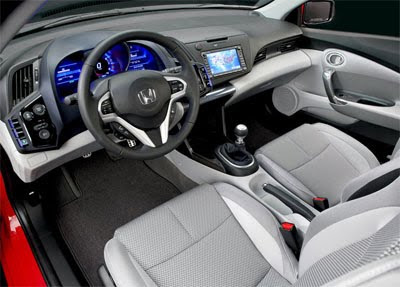
Expect an instrument panel with central tachometer and inset digital speedometer framed by graphics for engine info, warning lights and economy data. Most controls will be on stubby pods on the sides of that panel or the multifunction steering wheel, for an uncluttered dash. Despite the diminutive fastback styling, Honda's clever packaging should allow enough cargo space to hold some overnight bags, if not the ubiquitous two sets of golf clubs.


Lotus Malaysia today officially launched the Evora sports car for the Malaysian market, just under two years after the 2+2 seater mid-mounted engine, rear-wheel drive sports car made its debut in the British International Motor Show in London.
The Evora is powered by a Lotus-tuned Toyota 2GR-FE 3.5l VVT-i V6 block, offering 276bhp and 342Nm of torque, which is mated to a six-speed manual transmission, with close ratio sports option available. Performance specs include a top speed of 261kmh and a 5.1sec 0-100kmh sprint time.
Various features abound in the 1,382kg vehicle, depending on the pack levels specified, and these include an interior wearing fully-adjustable Recaro leather seats, cruise control and an Alpine touch-screen multimedia head-unit, which is paired to a two 50 watt power amp/6.5-inch ¼ coaxial two-way and dash-mounted tweeter speaker system featuring full connectability to iPod models with a dock connector.
Other mod cons in the available packs include rear parking sensors and rear view camera, a tyre pressure monitor system, power folding side mirrors, a remote release glove box and Isofix fastening points in the rear seats.
There's also a choice of four leather trim colours, available only if you go for the top of the line Launch Spec package; these are Oyster, Charcoal, Chestnut or Paprika.
The car rides on a fully-independent suspension layout featuring forged aluminium unequal length double wishbones with integral joints, Bilstein monotube gas dampers and Eibach coaxial coil springs. Standard fitment includes ABS, EBD and hydraulic brake assist.
A Bosch electronic differential lock and a switchable traction control system, along with 18-inch front and 19-inch rear cast alloy wheels wearing 225/40 front and 255/35 rear Pirelli P Zero rubbers are additional items on the kit list, as is an AP Racing four-piston fixed aluminium alloy two-piece calliper brake system, which is equipped with 350mm front and 332mm rear discs.
The Evora is available in four variants in Malaysia, and these are the Sports Spec, which goes for RM443,480, the Tech Spec (RM463,650), Sports & Tech Spec (RM472,110) and the Launch Spec edition, which is priced at RM490,210. You’ll have to be a little patient if you’re thinking of buying this zoomer, since there’s a four to five month waiting list for one.
Lotus Evora


Please LIKE , Tweet , +1 and Share if you like this article...

The Satria Neo s2000 Rally Car is installed with a 4-cylinder 1998cc DOHC normally aspirated engine which is based on the 1.8 liter Renault engine in the Waja. It produces 280hp at 7,800rpm and a massive 271Nm of torque at 7,000rpm, and is installed transversely at the front of the car. This engine is mated to an Xtrac 6-speed sequential transmission with Alcon clutch and 3 player LSD.
Proton Satria Neo S2000 Rally
Please LIKE , Tweet , +1 and Share if you like this article...

